8.17.2013

Transference: what does it mean, and what does it offer to music?


A piece of music may be deeply transformed by transferences, and by this reason transference is a powerful tool for music composition and performance!

Transference is a phenomenon in which qualities, values and/or concepts related to something become associated with (or are redirected to) a music composition, altering the way we listen to it.

For instance, when a Japanese Shakuhachi flute, a toy piano or a heavy metal guitar play a melody of Vivaldi, we get more than a timbre change only. Several qualities, values and concepts associated with these instruments are transferred to our listening experience.


However, transferences can also be carried out by other means. It can also be accomplished by particular performance procedures, specific timbres and special references to music itself. 

I have written a paper on this matter showing many examples of transference, and you can freely access this paper at the Musica Hodie Review (in Portuguese):

ZAMPRONHA, Edson (2013). “Transferência: o que é, e o que oferece à música?”. In: Música Hodie, vol. 13, nº 1, p.8-18.


Listen to an example: 
Lamento, composed by Edson Zampronha, wonderfully performed by the great pianist Karin Fernandes!


In Lamento transferences result from references to music itself, including the music of Stravinsky (particularly in the middle of the work), the European romantic music and some figures of lament from renascence (a falling sequence of notes that becomes simply a long appoggiatura in Lamento).

Pay attention to the long trill in the middle of the work:
  • At 2'50" it is an accompaniment to a melody plenty of figures of lament. 
  • At 5'00", after a sequence of powerful chords, it occupies all our attention changing our perception (as well as we listen to the sound of a word - instead of its meaning - when repeating it many times in high voice). 
  • At 5'50" the trill slows down and it is transformed into a figure of lament. 
These trills transfer outstanding qualities to the work. Besides, the long trill at 5’00” is clearly a transition through transference (it is a kind of modulation): we go from a sound meaning to the sound matter, and go back from the sound matter to a new sound meaning.

We do not have to be conscious of that, as we do not have to be conscious of harmonic progressions to listen to a traditional piece of music. In stating that, I am not saying that music is a universal language. No, it is not. However, there are music designs that are so common to some audiences that listeners associate them to specific music repertoires, and qualities from these repertoires are transferred to new music experiences. That is what makes transferences possible.


Lamento is one of the pieces included in the CD S'io Esca Vivo, which will be released in September. Other pieces in this CD are Ciaccona and Fantasia. Listen to these works and enjoy many kinds of transferences! 


8.05.2013

Fantasia receives a superb performance!


Karin Fernandes recorded works of Edson Zampronha in her new CD S’io Esca Vivo, and it includes a superb performance of the work Fantasia!

Fantasia was composed for clarinet, violin, cello and piano. It comprises a set of short musical segments (20-30 seconds long) that are connected for the production of a surprising and appealing diversity of expressions.  

Listen to Fantasia and experience a rich diversity of expressions!


Karin Fernandes recorded Fantasia playing with a great team of performers! They have put a lot of themselves into this performance, and we can feel it! They are:

Ana de Oliveira, violin
Luis Afonso Montanha, clarinet
Adriana Holtz, cello
Karin Fernandes, piano

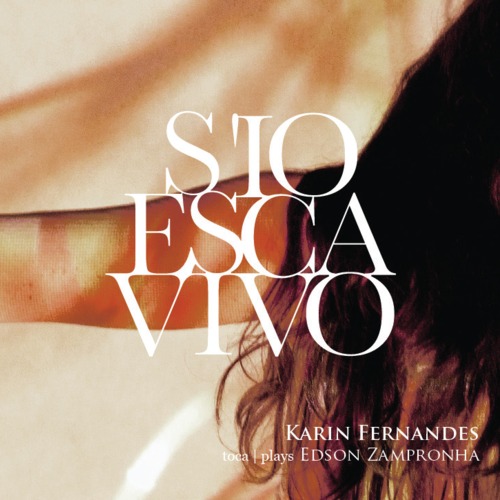
Also take a look at the great cover of the CD S'io Esca Vivo (below) 
(design and pictures by Gabriel Victal and Karen Montija).

All details have been fulfilled to accomplish a perfect CD!

S’io Esca Vivo will be released in September!


7.30.2013

A prodigious performer in action!


On September Karin Fernandes releases a new CD fully dedicated to the music of Edson Zampronha. This CD includes works for solo piano and chamber music with piano. It also includes a piece for three pianos, and she herself played all three!

S’io Esca Vivo (“If I come out alive”) is the title of this CD. It has received a super professional production. Excellent performers play with Karin Fernandes in a wonderful studio. The CD includes an amazing booklet, nice photos, and creative notes about the works.

Karin Fernandes is great! She is gifted, she has a great piano technique and a deep musical understanding and feeling. She belongs to that very special group of performers that are able to offer us a unique, captivating and fully convincing and unforgettable listening experience.
My music happens in the limits of my own imagination! I love that, and it is amazing when it pushes me ahead, and I eventually discover new lands for music expression  - Edson Zampronha.
This very special CD is being released in September! It will be announced here soon. You cannot miss it!


7.18.2013

Recycling Collaging Sampling is performed at the International Winter Festival in Campos do Jordão!!!


The International Winter Festival in Campos do Jordão (Brazil) is the most important classical music festival in Latin America.

In this edition, the Festival includes Recycling Collaging Sampling in its concerts! Edson Zampronha composed this very exploratory work for a variable number of percussion players and electroacoustics. 
Recycling Collaging Sampling, by Edson Zampronha, as I see it!

In Campos do Jordão, six percussionists from the Festival play more than 90 instruments on stage. The work takes about 23 minutes, and you will not even have time to blink!

Do not miss this unforgettable experience! It is going to be performed at the Espaço Cultural Dr. Alem (Campos do Jordão, Brazil) on July 19, 2013, 18h45. Free entry!

In the same concert you will be able to listen to the American Brass Quintet of the Juilliard School!

Listen to Collaging here, performed live by the Simantra Percussion Group in Portugal. It is thrilling!


6.21.2013

"Melody" is a top-down improvisation!


Improvisations are a fruitful context for finding or creating something new. In the work Melodia (Melody), composed by Edson Zampronha, some known compositional strategies are blend in a different way for achieving both a free state of mind (to me, an improvisation in its deepest sense) and a compelling musical thought.

How this blend is achieved in this work? Listen to Melody performed by Carlos Orobón and Edson Zampronha. After the concert, a significant part of the audience were quite curious to look at the score for understanding what had been actually written down. At least to me it does not seem to be a typical chance music improvisation due to many synchronies in pitch, morphology, recurrent figures, time and global shape.

Carlos Orobón and Edson Zampronha play Melodia (Melody), by Edson Zampronha, performed at the Main Theater of the Conservatorio Superior de Música de Asturias (Oviedo, Spain) on April 17, 2013.

In Melody improvisation and the global musical plan occupy different hierarchical levels. Improvisation occupies the higher level, and the melody in a lower level becomes a deep structure that guides the work. (Click here to see how it occurs in a sound installation as well.)

This procedure is similar to a baroque music in which we find a melody, a bass line (technically a thoroughbass), and ornaments created on these grounds. Unlike a baroque music, Melody squeezes thoroughbass and melodic line into one single line. 

However, in Melody ornaments can partially change the deep melodic line, creating the special case of a top-down musical organization (a higher level designing a lower one).

This is a special procedure that produces effective results. Improvisation becomes more than embellishments or variations. It recycles and redefines the ground on which it is firstly conceived, and it becomes partially structural. I suppose this is the main point here.

It is great to listen to Carlos Orobón and Edson Zampronha playing in this video. Carlos Orobón is a very creative and very gifted performer that is able to unify a high technique and a superb musical understanding, and he has deeply interacted with Edson Zampronha for the creation of this very special performance. Listen to it again, you will enjoy it even more!


3.20.2013

Camilo Irizo interviews Edson Zampronha!


I love interviews! They allow me to establish an immediate contact with the audience and performers, and to face complexes subjects directly, offering to the reader some “direct to the point” answers.

In January the great clarinetist Camilo Irizo interviewed me for the new issue of Espacio Sonoro review (Revista Espacio Sonoro). He posed me some questions of this kind, and I loved that. Here is a short selection of his questions, going from some more generalist to some more specific ones:

What differences do you identify between Brazil and Spain?
Is there anything specifically Brazilian in you music?
What new features do your work offer to the listeners?
Why do you work with so different musical styles instead of concentrating on a single one?
Expressivity highlights in your work. How do you produce it?

Ah! It is not so simple to say what my music offers to listeners in just a few words! My answer could be meaningless, excessively general, or a cliché. Instead, a good answer should offer the readers an essential piece of information, awakening the curiosity for a stimulating, thrilling and unforgettable musical experience!


You can access this interview online (for free) at Espacio Sonoro Review (in Spanish). The complete bibliographical quotation is:
IRIZO, Camilo and ZAMPRONHA, Edson. “Entrevista a Edson Zampronha”. In: Espacio Sonoro – Revista de Música Actual. (nº 29, February 2013)
(http://espaciosonoro.tallersonoro.com/2013/02/25/entrevista-a-edson-zampronha/ - March 20, 2013).

Would you like to go deeper in this subject? I recommend two other publications you can get online (free):

In English: Edson Zampronha interviewed by Ton Moore. This is a more biographical interview.

In Portuguese: Edson Zampronha. This is a speech I offered at the Centro Cultural São Paulo (São Paulo Cultural Center) including biographical and aesthetic views (it starts on page 59).


2.21.2013

Maria de Lourdes Sekeff – a new essay on Music, Philosophy and Psychoanalysis


Is there unconscious in music?

This is the question Professor Maria de Lourdes Sekeff poses herself in her magnificent essay Filosofia, Psicanálise, Música: Tema e Variações (Philosophy, Psychoanalysis, Music: Theme and Variations) included in the recently published book Quatro Ensaios sobre Música e Filosofia (Four Essays on Music and Philosophy), organized by Rubens Russomano Ricciardi and Edson Zampronha (Music Department of USP and Coruja Press, 2013).

This book is dedicated to the memory of Professor Maria de Lourdes Sekeff (1934-2008), including this original and unpublished essay. Professor Sekeff touches very interesting and even disturbing issues, which rarely receive a so fine approach.

Professor Sekeff starts explaining some aspects of Sigmund Freud thinking, and she explains how far his thinking takes us apart from the philosophy of René Descartes. For instance, she shows that truth is not a product of our thinking, but a product of our unconscious and our desires. And: for psychoanalysis the subject is the unconscious subject, a subject that is constructed (it is not born; it does not develop).(See here another text on this subject by Prof. Sekeff) 

Left: Professor Maria de Lourdes Sekeff  /  Right: Cover of the book including her essay. 


Afterwards, she shows that there is unconscious in music, and it can be observed in what she calls three dimensions:


  1. The first dimension is related with latent relations and senses that a work exposes to a listener, which are not readable in the surface of music.
  2. The second dimension is related with traces, marks that a composer leaves in the construction of his/her work. The composer’s unconscious is inserted in his/her selections, choices, structures and so on. In a nutshell, the composer’s unconscious is revealed by the way a composer says what s/he says. (Perhaps the Genetic Criticism can give a hand in this dimension.) 
  3.  The third dimension is related with echoes and resonances a work leaves in the listener. Professor Sekeff mentions the excellent book of R. Mezan (Interfaces da Psicanálise. São Paulo: Cia. Das Letras, 2002). She remembers that a musical work is complete only when the listener is included in the process, and that the unconscious is constructed in the relation between a work and a listener. Besides, that a psychoanalytic view is able to reveal some effects a work produces on a listener, and how some latent meanings can emerge during a listening, producing some reactions.

Professor Sekeff concludes explaining some ideas about signification and meaning in music and some other very interesting ideas that gives us an original perspective about music and its relation with a listener.

The themes approached in her essay are both complex and deep, and the comments I include here are just a short selection of ideas taken from her incredible set of original approaches to music.

The complete bibliographical reference to this book is:

RICCIARDI, Rubens Russomano and ZAMPRONHA, Edson (Ed.). Quatro Ensaios sobre Música e Filosofia. Ribeirão Preto: Coruja Press, 2013. (In Portuguese).

It includes the following essays by:
- Maria de Lourdes Sekeff
- Rubens Russomano Ricciardi
- Alexandre da Silva Costa
- Edson Zampronha